



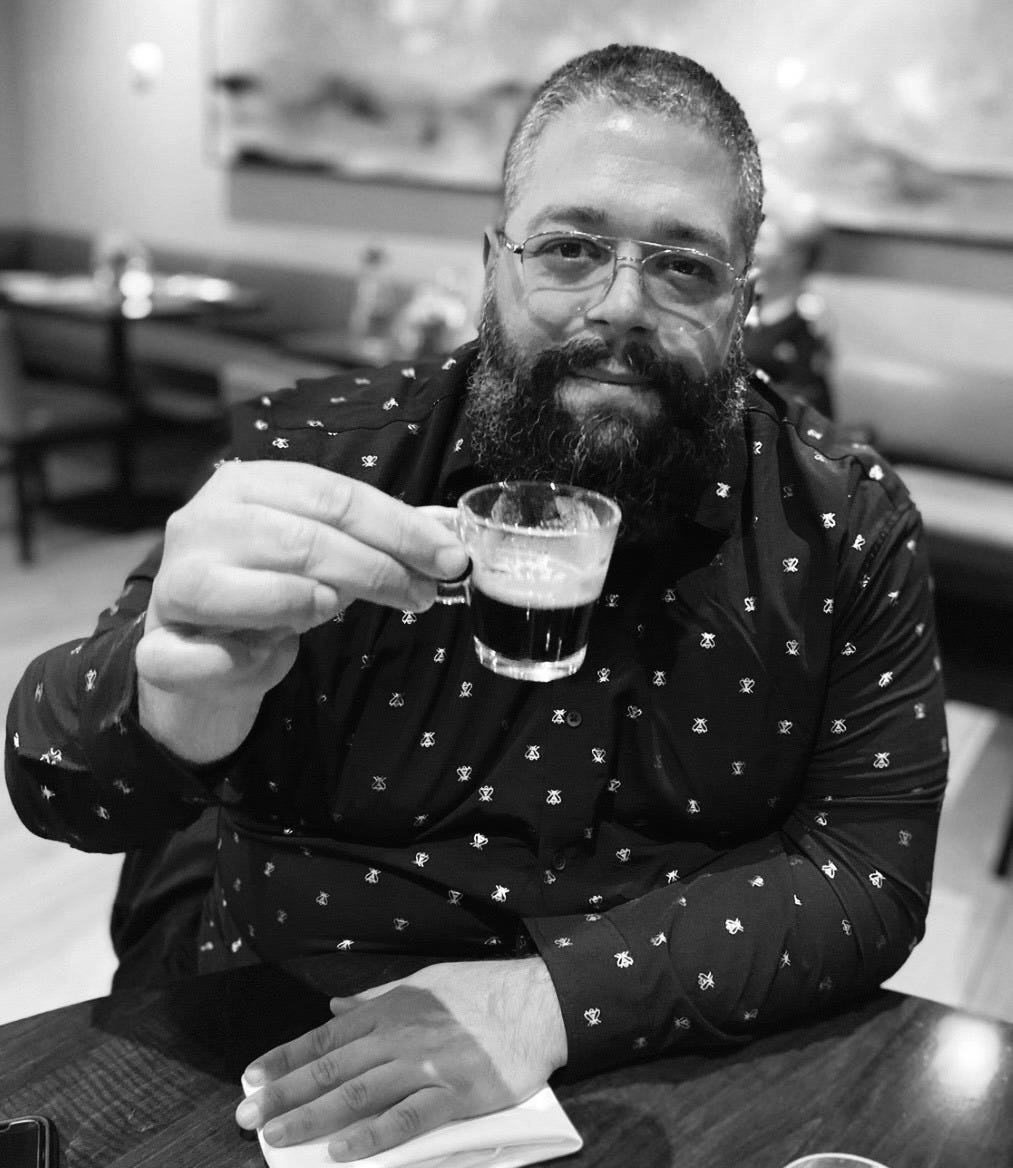
For Context: Dr. Jon Massimi
Episode # 03
🎙️ Episode Overview
On this episode of For Context, Dr. Jon Massimi, another Canadian, joins Luke and Gino to discuss contextual theology. Jon is a graduate (second cohort!) of the Doctorate in Ministry in Contextual Theology program at Northern Seminary. They discuss how contextual theology works in every day life by changing our posture toward our neighborhood. Whether the conversation is focused on the Eucharist or AI and Pentecostal memory, this episode is worth your time. Listen in!
For Context is sponsored by Northern Seminary. To learn more about the Contextual Theology program (or any of the number MA, M.Div, and D.Min offerings), visit seminary.edu.
📚 Resources
Gino Curcuruto: Following Jesus Into the Ordinary
Luke Stehr: Faith In Situ
🤝 Join the For Context Community
If you enjoyed this deep dive, consider becoming a paid subscriber to help us keep providing the context behind the news.
Subscribe to the Newsletter: forcontextpod.substack.com
Leave a Review: Apple Podcasts | Spotify
Episode Transcript
Gino Curcuruto:
I am Gino Curcuruto.
Luke Stehr:
I’m Luke Stehr
Gino Curcuruto:
And you’re listening to For Context,
Luke Stehr:
A podcast about Northern Seminary’s Doctorate of Ministry in Contextual Theology. Today on For Context we have Jon Massimi. Jon Massimi is a professor, speaker, and experiential learning designer who helps leaders, educators, and the curious turn experiences into insight and connection. His work explores how faith community and the gifts of ordinary people can reshape how we face complex challenges.
Gino Curcuruto:
I loved having this conversation and I know you did too. Luke, this is a great episode and I hope that you all listening enjoy it as well.
Luke Stehr:
All right, Gino. Today we’ve got Jon Massimi who’s here with us. Jon, why don’t you just tell us a little bit about yourself, where you are and how long ago was it that you went to Northern? Because I’ve never met you. I don’t know that Gino’s ever met you, so I think it’s been a little bit since you graduated.
Jon Massimi:
Well, I find myself in Kitchener, Ontario, Canada. Before that, I was in a town called Branford, Ontario. I’m mentioning that because it is the birthplace of Wayne Gretzky and since nice,
Luke Stehr:
Notable
Jon Massimi:
Hockey, it’s a Gretzky town there.
Luke Stehr:
Do you feel like being from the same town as Gretzky helped you with Fitch?
Jon Massimi:
Somewhat. Somewhat. I think navigating the hockey metaphors and Hauerwas was a skill.
Gino Curcuruto:
That’s great.
Jon Massimi:
So when did I start the program? I started in 2013 and then from there graduated 2017.
Luke Stehr:
That’s awesome. What made you want to go into a program focused on contextual theology?
Jon Massimi:
When it first started it was Missional Leadership and that was the buzz at the time.
So we all started Missional Leadership, my denomination, so I’m an Anglican priest, like that idea of leadership and wanting people to take charge. And then midway through the program it changed to” contextual theology, which I think is actually a better term to use. So what drew me into the program, it was very much relationships. I saw Fitch at a couple of gatherings in and around town here, so London, Ontario. So that’s about two hours where I am, and just found that he had similar connections and we knew similar people and I was just sharing my desire to continue my education and he goes, “Hey, I’m starting this new program.” And he goes, “come check it out.” So I missed joining the first cohort. I was the second cohort of the program. So before putting an application, I took a drive to Lombard and met with Fitch, brought my family, went to the old seminary, I guess Fitch comes out of his office with t-shirt and jeans and hey, he’s like, dude hugs me. And I said, I drove from Kitchener. This is about eight hour drive. You have any free books for me? He goes, “Hey, I’m not Scot McKnight.” And then I already know the dynamic there, but I already had his books that he had. So anyway.
Gino Curcuruto:
That’s great.
Gino Curcuruto:
Jon, what do you spend your time doing these days? You said Anglican priest, but also I believe you’re a professor as well.
Jon Massimi:
Yes. So the trajectory I was doing church planting when I first started the program and like all good Anglican diocese, they’re really great at that. No, they’re not. You got things started and it’s like, oh, there’s some traction going on here. Let’s create a regional ministry. That didn’t really work out. And I transitioned to working with United Way in neighborhoods, and
That shift occurred kind of I would say midway point of the program. So I had a particular topic in mind and it completely shifted because of that work with United Way I started off. It sounds a position that sounds a little bit more important than it was. It was at first a neighborhood development officer. There were no badges involved, so just there it was building relationships within the community. And then I moved to being a manager of community development and then from there started working with my municipality. So I became a supervisor of community centers. So I had five community centers and every community center had a church plant in it.
Gino Curcuruto:
Oh, wow.
Jon Massimi:
So I was meeting with more pastors than ever and I started just gathering at my house. I’m like, let’s talk about what’s happening in the neighborhood and maybe it’s put some theological framing around it. And one of the participants worked at Martin Luther University College, so that’s where I’m at as an adjunct and they needed someone to teach a course and she goes, “I know someone.” So that started the journey there. I think I’m up to eight courses. I don’t teach ‘em altogether. It’s like eight courses.
Luke Stehr:
That’d be a crazy load.
Jon Massimi:
Yeah, it would be most definitely. And then with that, I also do consultancy work, so I do work with neighbor associations, municipalities, I’ve worked with churches and from that I landed in, started a travel company too. I do educational travel and experiences. So there’s been situations where I’m working with a client and I’m like, that’s really a cool idea. Let me take you somewhere and that somewhere could be up the street, another city, or let’s go to another country and see what this is about. So that’s where I’m by myself and I’m currently in my home office with my kids barred in another room, so
Gino Curcuruto:
That’s great. I’m also curious about your experience in the program knowing that it was, you said the second cohort, so I’m sure some things have developed and maybe you’ve had a view of that on the way, but what were some of the seminars that were impactful for you?
Jon Massimi:
Well, I think right out of the gate, my first class with Fitch where we were talking about what are the essentials of the church. So framing that, and I think I came... so back up a bit. I’m not a cradle Anglican, so my family was Roman Catholic, grandpa became Pentecostal. So the emphasis growing up for me was Jesus in your heart, personal relationship. And I’m going to throw this out right now because Fitch is also known for his Hauerwas interpret or impressions. So I was at this Hauerwas event and someone asked, “Dr. Hauerwas, what’s your view on having a personal relationship with Jesus?” And I’m not going to do the impression. He’s like, “well, I don’t find having a personal relationship with Jesus that interesting.” And she, because Christianity is a mediated faith. So for me, that was one of the main learnings because I came in with this, yes, I was in the Anglican church, liturgical formation was big, but there was still this theological hangnail where it was, Hey, I need to have a personal relationship here. And in that it was this Christology that came first, but emphasizing, okay, ecclesiology first this appreciation of the church and that we have this mediated faith and we receive a story that we in turn pass on in our shape by. So that was one of the main learnings.
Gino Curcuruto:
That’s good.
Jon Massimi:
The second thing I appreciated was our after class hangouts with Fitch. So that’s where I found in the class we did listening and we had some discussions, but the heavy lifting I think happened around Fitch’s kitchen table or patio where we, and that would also be the opportunity. He would come out with his letter from Hauerwas show us that, and then later
This was a later edition, the autograph picture by Wayne Greg from Wayne Gretzky. So that was my connection to Branford. We hooked up that deal for him, but it is that, and I truly appreciated how he made time for all of us, and I think that also helped us forge relationships with one another. So we weren’t just relying on him, we were also bouncing ideas off of one another.
Gino Curcuruto:
Wow, Jon, that’s so good. That’s come up with in other discussions we’ve had with people. I’m glad to hear it. It’s a good reminder because the program in a lot of ways is promoted, if I can say it that way, as look at these amazing professors that you get to learn from. And that’s true and that’s good.
Luke Stehr:
Yeah, they’re amazing.
Gino Curcuruto:
They are amazing and I hope that draws people in. But at the same time, it seems like the people who have gone through this program emphasize yes, the professors and maybe even more so how they cultivate these relationships in the cohort. Luke, I don’t know if some questions come to mind for you, but I could go down that Hauerwas rabbit trail with Jon no problem. And might do that. But I’m going to give you this.
Luke Stehr:
I think before we get there, I think this is helpful because I know there are probably some people who are listening who are deeply familiar with contextual theology and the majority probably are not familiar with contextual theology as a concept. So you talked about this transition of the program being a missional leadership program to a contextual theology program and why you think that’s ultimately a good thing. So can you explain why that’s a good thing, why that transition makes sense? Why we would want to think about missional leadership and contextual theology in different ways?
Jon Massimi:
I think when we emphasize leadership, there’s an assumption at play that we’re entering into spaces with answers and authority and particular power postures. So when I say I’m the leader, I’m at the front of the room and other people follow me. So when I talk about missional leadership, it was that we as leaders were the primary guides into the community
And we set the terms of engagement and we were the paid professionals that others relied on. So the shift when we’re talking about contextual theology, so it’s that shift from being, having the answers to entering into spaces with questions. So when you’re a leader, I think there is the temptation to be helpful; when you’re entering in contextually it’s entering with as someone who’s curious, asking questions like, “what may God be up to here?” It’s also allows you or opens space for others to participate in it. So the other component I appreciate it is this wrestling with our context, the message that we received, and there’s also this idea of discernment of how does the message that we received apply to where we find ourselves and in turn, how is God speaking to us through our context? My thesis or dissertation topic was around asset-based community development. So that is a practice created by John McKnight, and in short, it’s entering into places and communities seeking abundance, not focusing on scarcity. So that transition or even the idea of leadership could lead you toward a model or an approach that seeks out needs and focuses on scarcity.
When I find with the contextual is God’s already active, God’s doing things, God’s not absent and God gives us the gifts and the resources we need to engage with that context.
Gino Curcuruto:
So do you ask different questions? I guess you ask different questions right from the beginning then when you’re thinking contextually what are the assets here versus what are the needs? But also do you think about how the idea of the context is shaped by the cultures that are there. And so we also have to take into account the self that comes in as the help is also shaped by a context or how we even view the self as well. I don’t know, did you engage with that in your work there?
Jon Massimi:
Yeah, we enter with baggage. So ethnography is a big part of the program. So you have participant observers, you’re entering into spaces, you are observing the space, but as you were mentioning, your presence shapes the space as well, being attentive to that. And it is uncovering stories and seeing how the stories draw us into God’s story. That’s how I understood it. And when I am listening to stories, I found that there were two impulses happening. So the first was this nostalgic impulse where people would look back on how things were and would grieve that and said, “if only we could go back to the good old days,” whatever that was. The other impulse or perspective is this utopic. So it’s like looking to a state of perfection or so Thomas Moore, utopian means no place so we can never actually attain it, but saying if only we can get there. And what I’ve learned is those two impulses both start with if only we, and that “if only”t invades the present with scarcity,
It’s saying that we don’t have what we need now. We had it then and it’s gone. That could be larger crowds, buses of kids coming to Sunday school, whatever. And we also look at the present and say, we don’t have enough to take us into the future. So I spent years as a youth pastor on 10 hour a week contracts because it was, we need young people in our church and we need someone who’s hip and young to get them in. So we’re going to hire you and we’re going to expect you to bring in young people. Mind you, the congregations that did hire me were predominantly seniors. So when I’m looking at this with the scarcity mindset, then bringing it into conversation, liturgically for me, the Eucharist is central. The Eucharist teaches us two different impulses. So how do we look to the past, not grieving it or with nostalgia, but with thanksgiving. And then again, the Eucharist is not just a remembering, it’s a, there’s some eschatology happening, it’s looking to the future. So it gives us and allows us to look to the future with hope. And it thoroughly grounds us in the present. And in the present. It teaches us that God gives us what we need in the bread and wine and that God is enough and that we are enough for the moment.
So that’s the framing over the years that was going on in my head. So again, starting in, Hey, I’m a leader. Let me be helpful. Let me show you the way. And then people start telling me their stories. Oh, do you remember when, let’s recreate this. Do you remember when we used to sing Shine Jesus shine or shelter the Lord? And how many people raised their hands? Okay, let’s forget about that. Let’s look on that at thanksgiving. Thank you God for what you’ve done and what is God doing now?
And when I would enter as a youth pastor in those contexts, I didn’t have that language even to make sense of it myself. And I found that this program gave me a language not only to help me understand what was happening, but also to share with others and frame the conversation in different ways.
Gino Curcuruto:
Jon, you just connected something for me that’s really feels very significant in your discussion of the Eucharist right there. And it’s the quote that you’ll know that because Fitch always says it as Hauerwas when someone says, where is this church that you are talking about? And Hauerwas will always say it’s right where you are. But I think you just gave some framing for that because this church exists where you actually are, not where you long to be in the past or hope to be in the future, but where you’re thankful for the past and the future is invading the present eschatologically in some way. Is that a connection that you’ve made to when you hear that quote or when you hear if it is poor impersonation of
Jon Massimi:
Yeah, I do. I do.
Gino Curcuruto:
That’s super helpful to me.
Jon Massimi:
Yeah. And again, it is that because if we start seeking, I know in Canada, especially for the mainline church, so I’m working with Lutherans and I’m working with Anglicans, and it is a difficult time because those that have come through seminary we’re told that if you give a bang up sermon, if you do an amazing children’s focus at the front of the church, if you have soup kitchens and maybe a contemporary band, a lot of people will come. And our context and the communities around us are changing. So the pocket in which I find myself in is there’s a new mosque that opened up the street. So what does that mean? What does that mean for Shrove or Fat Tuesday pancakes and sausage. Hey, you want to come and have some non-halal sausage and pancakes, or is there a way that we can reach out in different ways? So it’s also that idea, and I know this comes out in the course as well, this attractional model that we set up all these things and people come to us, but it’s actually us going out. And when I look at the Eucharist, one of the things pronounced at the Eucharist is taste and see that the Lord is good.
And I think when we gather around the table, it trains our palates so that we’re able to taste God in the neighborhood. What does God taste like?
Luke Stehr:
What a way to say that.
Gino Curcuruto:
Yeah,
Luke Stehr:
That’s beautiful.
Gino Curcuruto:
Yeah, that’s really good
Luke Stehr:
I mean, so, as you think about where you are now because of this program, what does life look like for you as a contextual theologian on the ground day to day?
Jon Massimi:
Well, first, I no longer have dreams of being a mega church pastor, so a little
Luke Stehr:
This program will cure you of that.
Jon Massimi:
Yes. In my day to day, what I find is I seek ways or I would say I try to be more attentive to what’s happening around me and to what God may be doing.
So when I’m interacting with my neighbors, when I’m out, and I even think using the practice of ethnography allowed me to take in everything. How is this space speaking to me, how people are interacting around me, what is that saying? And one of the practices that I also engage in because of ethnography is I’ll walk my neighborhood during garbage day because what people throw out say a lot about them. So if I’m seeing a house with a lot of toys on the lawn and loads of pizza boxes, I’m like, okay, and hockey net, oh, maybe this is a hockey family that they’re always on the go and pizza is their primary meal on the go, and they’re very networked if you want to say it. They’re doing a million different things. So that’s one thing. Or I dunno, maybe some people drive by or walk by my house and say, what’s with all the beer cans anyway? Sometimes they have parties in the back area. We have a fire pit,
Like I said, I grew up Pentecostal, but Italian Pentecostal. So you’re allowed to drink wine but don’t dance. Fair
Luke Stehr:
Fair enough. So I want to draw on something really interesting that I think this program does and has done for you. And I think it’s a really good counterpoint to what we talked about earlier is I think in the process you’ve actually encountered what truly is a personal relationship with Jesus, which is this attentive life versus I think that kind of personal relationship we receive maybe out of the frameworks of evangelicalism where it’s really more of an intellectual like me and God are good kind of thing. Whereas you are now basically talking about this program has made you attentive to Christ’s presence everywhere you go, which is truly what a personal relationship with Jesus is. And I would just love it if you would elaborate on that.
Jon Massimi:
Well, I would say when you’re talking about the personal relationship, it’s the recognition that Jesus comes to us through others. So that’s that ecclesiology piece, but also Christ is coming to us through the stranger That we’re interacting with. So it is that openness, but it’s also the recognition that I enter into spaces as a stranger as well. And when we look at strangers, one of the things that we teach our kids is don’t speak to strangers and it’s a hidden curriculum. They’re saying fear the other because the other can do you harm. But with this program it’s saying, well, the stranger could potentially be God speaking to us, and then in turn we can be the revelation of Christ to others.
Luke Stehr:
That’s what I was getting at with the personal relationship. That’s not that interesting, but that’s that intellectual evangelical ascent model, not what you’re describing.
Jon Massimi:
Yeah. So year two of the program, I was doing the church plant thing and some people in the congregation were musicians. So, they were like, “Hey Jon wanted to come to one of our gigs?” Well, the gig was on a Saturday night and they were on at one in the morning being a good Anglican priest. My next service was at 8:00 AM morning prayer. So I went and I didn’t wear the collar, I didn’t want to be identified. And the bar was called Two Doors Down. I went in, ordered my drink and I was off in the corner. Then some other people walked in and they were recognized by others in the bar and they yell out, “Hey Michelle, what are you doing here?” And then she yells, “I’m here with my priest,” and she points at me in the corner. Well, what ended up happening, this little group starts gathering around me and people started asking me God questions. And I made the joke that God was two doors down and it was already at work, it was already preparing things there. I wanted to hide, but I was called out and people shared their horror, their horror stories of the church. And one person was like, “well, if I come, will you accept me? I would like my daughter to be baptized. Will you accept her?” So that conversation, so I think we got out of the bar at four in the morning and I just went right to the church and slept in the office. I went right to doing morning prayer,
I don’t remember what I was speaking on. It was a little groggy, but just that, right. It was okay, this is happening to me. And I was learning not to push it. It was like, just listen. I didn’t need to be the Bible answer man, in that moment. Right. You share and it’s a yes. I hear you.
Luke Stehr:
Absolutely
Jon Massimi:
People. So the other thing that comes out of it is Fitch’s three circles. So that was the semicircle, right?
Gino Curcuruto:
Right.
Jon Massimi:
How are we received? How are we a guest? I said he needs to
Luke Stehr:
A bit of a pause because not everyone’s familiar with the three circles model. So one of you two, because you both have, Gino especially has really oriented his life around it. You can just brief explanation,
Jon Massimi:
Take it on.
Gino Curcuruto:
Yeah. Well, I would say that the way Fitch describes it, he has three circles. He says that the church exists not in just one space, time and place, but in all of life. So as you described, these three circles also have a shape that’s designed to be memorable. There’s a close circle, which is a full circle, close, not closed. And that would be where we would enter that space as the recipients of God’s presence. There’s a connecting circle is what we call it. I think he calls it the dotted circle.
Luke Stehr:
I think you’re right.
Gino Curcuruto:
Yeah. So that would just be a circle, like a dotted circle if you can visualize that as you’re listening. And that is the place where we go as hosts of the presence of God in some way. So we might be welcoming people around a table in our house or somewhere else. And then there’s also the half circle, the semicircle, the open circle where we go as guests of God’s presence, seeking to find where God is present and at work, and then name that to others. So it could be two doors down literally or figuratively.
Luke Stehr:
People are laughing and having a party. So with that in mind, you found yourself in that semicircle that night. I totally interrupted you and derailed, but I wanted to make sure.
Jon Massimi:
Oh yeah, yeah. No, no, it’s fine. It’s fine. That’s good. Giving people context, right? Yeah, I found that helpful. And it’s also a tool to share with congregations. So the close circle is important. It’s where you learn how to be good hosts within the community and in turn be guests. Because in that process, it’s this reciprocal relationship where Christ is both host and guest in the lives of the believers. In the Eucharistic moment, I joke with Fitch, I’m like, you got to update those circles. You need one more. And I’m like, you need a Trinitarian circle. Start with that, how the life of Trinity extends into, and then let’s move forward.
Gino Curcuruto:
That’s really good.
Luke Stehr:
Let’s write that book.
Jon Massimi:
That’s an update. Yeah. The fourth circle.
Gino Curcuruto:
The fourth circle. I like what you said earlier, that close circle, if I’m using some of your language, Jon, is where we learn to develop the palette for moving into the other circles in a sense around tables and tasting and seeing and sharing that the Lord is good.
Jon Massimi:
And entering into the Anglican church and liturgy has been very important for me and it grounds me as well. And the thing is, when we’re looking at even the program I entered as an Anglican and those around me, so one of the benefits I had was hearing from different traditions as well. I think there was another Pentecost, I knew how to speak the Christianese enough to understand what he was saying, right, because I grew up. But what I loved about Fitch and his approach is he also valued tradition and liturgy and saying that those are important elements of our faith that help shape our postures in the world today. So wasn’t this abandonment of, let’s just go back to tax chapter two, right? No, there’s a church history, right?
Gino Curcuruto:
Yeah. You’ve heard him say this, but he said this multiple times in our first seminar. You don’t make this stuff up, you don’t make this stuff up,
Luke Stehr:
You don’t,
Gino Curcuruto:
And he’s right.
Luke Stehr:
Gino, one more question for Jon.
Gino Curcuruto:
Yeah, Jon. And I think as we kind of come towards our time to close here, I was wondering, it sounds like you’ve mentioned this, but maybe is there one other takeaway from the program that you’d want to share with us?
Jon Massimi:
Well, I would say that the importance of building relationships with other pastors. So I found that many, again, I’ve worked with Baptist, Pentecostals, Presbyterians, Anglicans, et cetera, and we tend to, especially if you’re in crisis mode, you want to be so insular and saying, okay, let me just focus on the growth in my church and my experience of connecting with others in the class and seeing others’ experiences positioned me to say, well,
I can learn from other traditions as well. Let me build relationships and see what God is doing in and through other leaders and other congregations. So how can we encourage and work together? And I guess this is a good comedic thing, a callback. So going back when I was supervisor of community centers, seeing all those pastors together and saying, you need to come and talk and work with each other. Because it ended up, and it wasn’t happening as much, but it could have where it was like, let’s see who can set up their brand the best rather than how can we work together for God’s glory?
Gino Curcuruto:
That’s so good. That’s so good.
Luke Stehr:
Okay. Secret surprise question. What are you reading right now?
Jon Massimi:
Oh my goodness. I’m really getting into spirituality and AI. I’m reading around that. So there’s a book here, Understanding Religion and Artificial Intelligence: Meaning Making in the Digital Age
Luke Stehr:
Gino was on a Panel about AI, and he’s totally an expert.
Gino Curcuruto:
I could have used that book four days ago. I was on a panel. Yeah, no, that’s fascinating. Who’s the author on that? I’m sorry. I don’t mean to put you on the spot if you have it in front. Randy Reed.
Luke Stehr:
Randall Reed
Jon Massimi:
And Tracy Rohan.
Gino Curcuruto:
Excellent.
Jon Massimi:
I I’ll show it too. It’s right here.
Gino Curcuruto:
There it is. Wow. Beautiful.
Jon Massimi:
I did listen to what Fitch was saying, I guess the first episode and how some students are going on to do other things academically. So for me, I’m in the process. I’ve applied to a program in Europe and I’m looking to write about this. So going back to my Pentecostal roots saying, how does AI shape Pentecostal memory? So we are a people of memory, and my worry is when we’re working in communities, we are no longer are able to hold memory and we’ve lost our sense of artifacts, everything’s own, right? So how are we passing on the faith in ways that are faithful and how are we accurately, or how are we holding memory? And when we’re looking at Pentecostals, eschatology is huge and they seek to interpret currently events well, if those events are already being curated through algorithms, there’s another layer of discernment that needs to occur as well.
Luke Stehr:
Man, that’s going to be good.
Gino Curcuruto:
Yeah. Wow. Keep going. Sorry, I don’t want to interrupt you. I was just going to say, Luke, I think we’re so new into this podcast and we already have someone that’s going to need to come on again already to talk about that whole thing.
Luke Stehr:
Yeah, there will be a part two, Jon, so stay tuned.
Jon Massimi:
Yeah, I could just upload my consciousness.
Luke Stehr:
I watched the show Upload and I think that’s a bad idea, but Well,
Jon Massimi:
And it is something for you both or whoever’s listening, I did do a class on the meaning of life in ai. So the three, I use movies to set out a framework. So the first movie is Lars and the Real Girl, the second is Her, and then the third is Ex Machina. And I brought that into conversation with Wendell Berry and he has three concepts that work there because of the draft tours package and the tractor package. And I’ll leave it at there. That’s little breadcrumbs for the next episode, man.
Luke Stehr:
Jon, I say this with zero sarcasm. I bet you are a lot of fun at parties,
Jon Massimi:
Let’s say there’s some cigars present. I refer to him as burnt offerings to make them sound like get under the radar with some people. But yeah, that’s good. We have fun. That’s so good. And the invitation to you both Luke and Gino? I do have, so I have a basement apartment, so my son lives there now, but anytime you want to stop in.
Gino Curcuruto:
Oh man,
Jon Massimi:
I invited Fitch. He came a year ago and we had a bonfire invited pastors in the area and we hung out, and then we did a Saturday night with him, and then he spoke at a church. So
Gino Curcuruto:
Nice.
Jon Massimi:
It’s slowly being referred to as the philosopher’s basement, so different people are coming and
Gino Curcuruto:
I’m there. I’m coming. Yeah,
Luke Stehr:
I make get to Canada like twice a year, so this may happen.
Jon Massimi:
Yeah, you’re more than welcome. And it’s in the summer. It’s a bonfire winter. We’ll figure it out.
Gino Curcuruto:
Well, I return the offering, but no one wants to come to the US right now. And I totally understand. But if you ever do, we’ve got a spot for you as well. Oh man.
Luke Stehr:
Thank you. We’re good. Well, Jon, thank you. And to everyone out there, thank you so much for listening.


